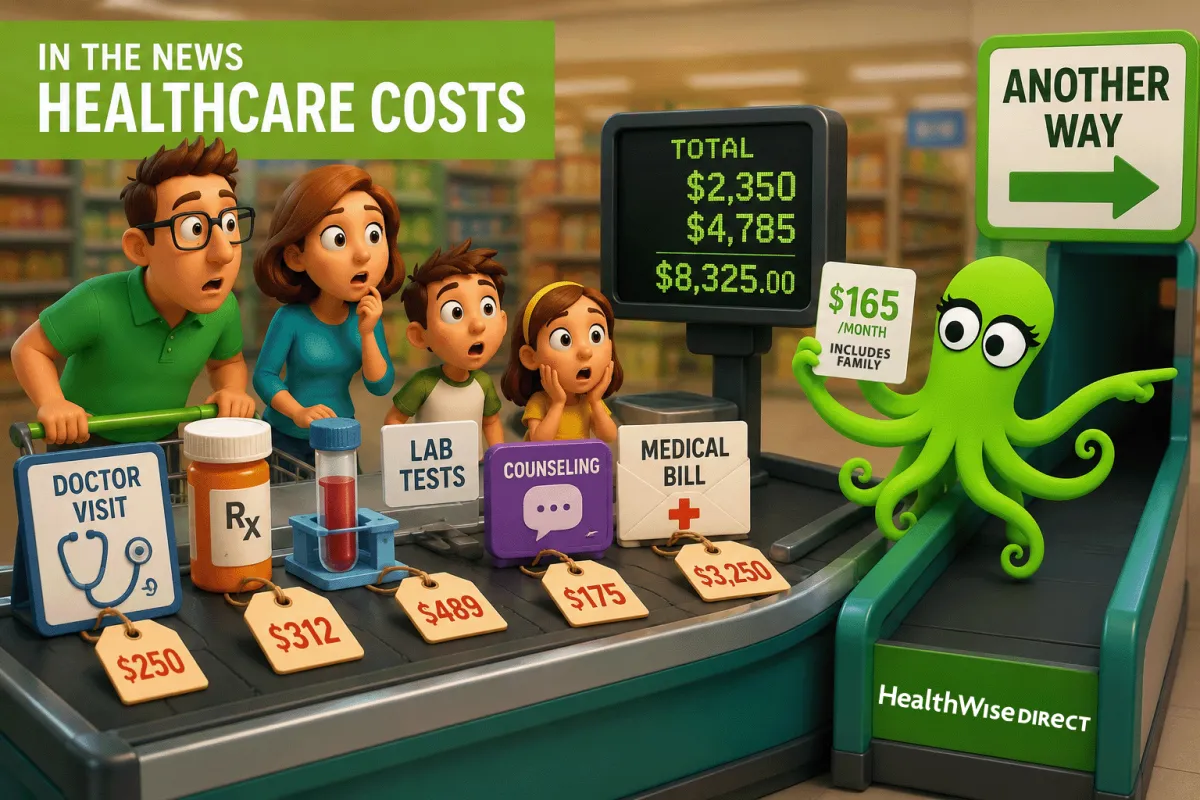
When Healthcare Costs Too Much to Use: Why Americans Are Looking for Another Way
There’s a strange contradiction happening in American healthcare.
We spend an enormous amount of money trying to protect ourselves from medical expenses. And then, when we actually need healthcare, many of us hesitate to use it because we’re worried about what it’s going to cost.
A recent survey highlighted on The Jimmy Dore Show put a startling number behind that problem: 92% of surveyed U.S. adults said they had delayed or abandoned some form of medical care because of cost.
That statistic deserves more than a headline.
Because the real story isn’t simply that healthcare is expensive. It’s what people are doing because healthcare is expensive.
People are putting off care because of the cost
The 92% figure comes from a survey of 1,507 U.S. adults conducted for financial services company JG Wentworth.
Younger adults were especially likely to report delaying or forgoing care because of cost, with the survey reporting the highest rate among adults ages 18–28.
That’s an important distinction.
This isn’t necessarily a story about people who don’t care about their health.
It’s about people making financial decisions.
Can I afford to go?
Can this wait?
What is this visit going to cost me?
What happens if they order labs?
How much will the prescription be?
Sometimes the answer becomes:
I’ll deal with it later.
And “later” can have consequences.
The podcast cited research indicating that some adults reported their health worsening after postponing a doctor’s visit. That’s where healthcare affordability stops being merely a financial issue. If the price of accessing care causes people to avoid accessing care, we have a much bigger problem.
Even a routine doctor’s visit can be expensive
You don’t necessarily need a major medical event to encounter significant healthcare costs. A 2026 Zocdoc analysis found that an uninsured primary-care visit can range from about $40 to $300, with an average of $171 across major U.S. cities.
And that’s generally the visit itself. Labs, imaging, procedures and follow-up appointments can add additional costs.
So imagine you’re a parent.
One person in the family gets sick.
Then another.
Someone needs bloodwork.
Someone needs a prescription.
Maybe somebody needs counseling.
None of those situations necessarily qualifies as a healthcare catastrophe.
They’re simply…everyday healthcare.
But those everyday expenses can add up quickly.
And then there’s medical debt
The financial consequences extend well beyond the doctor’s office. KFF estimates that people in the United States owe at least:
$220 BILLION in medical debt.
Approximately 20 million U.S. adults have significant medical debt, and roughly 14 million owe more than $1,000. About 3 million adults owe more than $10,000.
Think about that for a moment. These aren’t car loans. They aren’t mortgages. They aren’t vacations someone couldn’t afford. They’re bills connected to getting healthcare.
And medical debt doesn’t exist in isolation.
People dealing with healthcare debt report cutting spending on necessities, using savings, borrowing from friends or family and taking on other forms of debt. Healthcare costs eventually become household costs.
Prescription costs create another difficult choice
The same financial pressure shows up at the pharmacy counter.
The statistics discussed on the podcast included adults choosing over-the-counter medications instead of prescriptions because of cost, as well as people skipping doses or cutting pills in an attempt to make medication last longer.
Again, look at the decision being made.
It’s not:
“Do I want healthcare?”
It’s:
“Can I afford the healthcare I’m supposed to get?”
Those are two very different questions.
And healthcare costs aren’t expected to suddenly reverse direction
Perhaps the most concerning part of this conversation is what comes next. Health plans are projecting another significant increase in medical costs for 2027.
PwC’s 2027 medical-cost outlook projects a 9% medical cost trend in the employer-sponsored market and 8.5% in the individual market.
That would put medical-cost growth near levels not seen in almost two decades.
The podcast highlighted the 9% projection while discussing the broader trajectory of healthcare costs.
In other words:
If healthcare already feels expensive today, waiting for the system to simply become inexpensive again probably isn’t much of a strategy.
Maybe we need to start asking a different question
For years, most of us have been taught to think about healthcare choices in roughly the same way.
Which health insurance plan should I buy?
If one becomes too expensive, we look for another. Maybe we choose a higher deductible. Maybe we change networks. Maybe we accept different benefits. Maybe we pay a higher monthly premium. We’re comparing different versions of essentially the same approach.
But what if that’s not the only question we should be asking?
What if there were another way to approach healthcare?
That’s the question behind HealthWise Direct.
HealthWise Direct isn’t traditional health insurance. It’s a different approach that starts with something surprisingly simple: The healthcare people actually use.
Primary care.
Urgent care.
Lab work.
Prescriptions.
Counseling.
Health monitoring.
Help navigating healthcare decisions.
We call it Everyday Healthcare.
Everyday healthcare shouldn’t be something you’re afraid to use
HealthWise Direct provides 24/7 virtual primary and urgent care along with eligible lab services, prescription benefits and savings, virtual counseling, smart health technology and personal healthcare support.
The cost is: $165 per month.
And that includes your spouse or partner and dependent children. So when someone in your family wakes up sick…You have somewhere to start.
When you need primary care…You have access.
When you need lab work…It’s included.
When you need a generic prescription…It $0.
When you need someone to talk to…Counseling support is available.
And when healthcare gets confusing…You have someone who can help you navigate it.
That’s what we mean by: Everyday Healthcare, Made Simpler.
But what about the big stuff?
That’s an important question. Everyday healthcare isn’t the same thing as a hospitalization, major surgery, pregnancy, cancer diagnosis or serious emergency. That’s why HealthWise Direct also offers an optional Additional Healthcare solution designed for larger, unexpected medical needs.
It’s a different way of thinking about the healthcare equation: Start with affordable access to the healthcare you and your family are likely to use. Then consider additional protection for life’s larger medical events.
HealthWise Direct is not insurance, and it won’t be the right solution for everyone. But for people who are watching healthcare costs climb and wondering whether traditional health insurance is their only option, it may be worth asking one simple question:
What if there were another way?
Because the answer to healthcare becoming too expensive to use shouldn’t be:
Stop using healthcare.
Maybe it’s time to look at the options differently.
⸻
Sources
JG Wentworth survey findings as reported by The Independent, August 2026.
Zocdoc, How Much Is a Primary Care Visit Without Insurance?, February 2026.
KFF / Peterson-KFF Health System Tracker, The Burden of Medical Debt in the United States.
PwC, Medical Cost Trend: Behind the Numbers 2027.
The Jimmy Dore Show, discussion of rising U.S. healthcare costs, August 2026.
⸻
HealthWise Direct is not health insurance. HealthWise Direct provides access to specified healthcare services through contracted providers for a monthly rate. Optional Additional Healthcare is available separately and is subject to applicable guidelines. Review program details, limitations and eligibility before enrolling